Building Trust Across the Pharmaceutical Supply Chain: A Reference Architecture for End-to-End Traceability
A vendor-neutral reference architecture examining serialization, GS1 EPCIS, IoT, and regulatory systems.
Executive Summary
RA-001 examines how pharmaceutical identity, serialization, traceability events, enterprise systems, regulatory verification networks, and environmental observations interact across multi-party supply chains. It compares established approaches including GS1 EPCIS, U.S. DSCSA requirements, the European medicines verification framework, and evolving Indian traceability requirements. The architecture then identifies interoperability and verification boundaries where physical custody, digital events, environmental conditions, and organizational trust may need to be correlated across independent systems.
1. Scope & Methodology
RA-001 uses a vendor-neutral systems-analysis methodology. The research reviews primary regulatory material, industry standards, pharmaceutical serialization practices, enterprise-system boundaries, logistics handovers, and verification mechanisms across selected U.S., European Union, and Indian contexts. The analysis distinguishes regulatory requirements from industry implementation patterns and from architectural recommendations proposed by KryoNex Research.
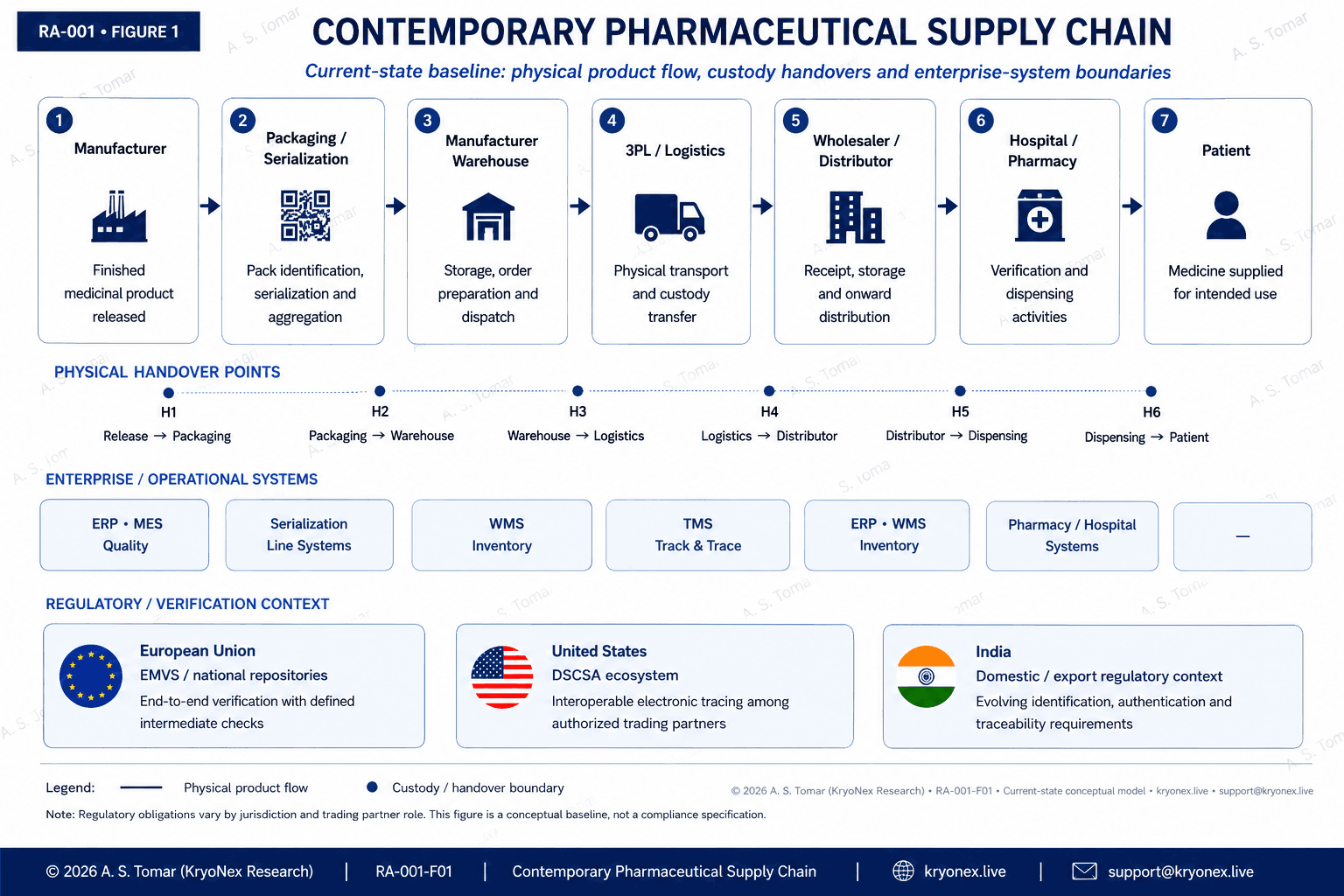
2. Contemporary Pharmaceutical Supply Chain
Pharmaceutical traceability has evolved from paper-based and organization-specific records toward increasingly electronic and interoperable systems. However, implementations continue to span independently governed enterprise platforms, trading-partner interfaces, regulatory repositories, and physical logistics processes. The challenge becomes managing the heterogeneity and integration boundary conditions across these distinct zones, rather than assuming standard end-to-end integration or uniform data models.
3. Current Pharmaceutical Traceability Landscape
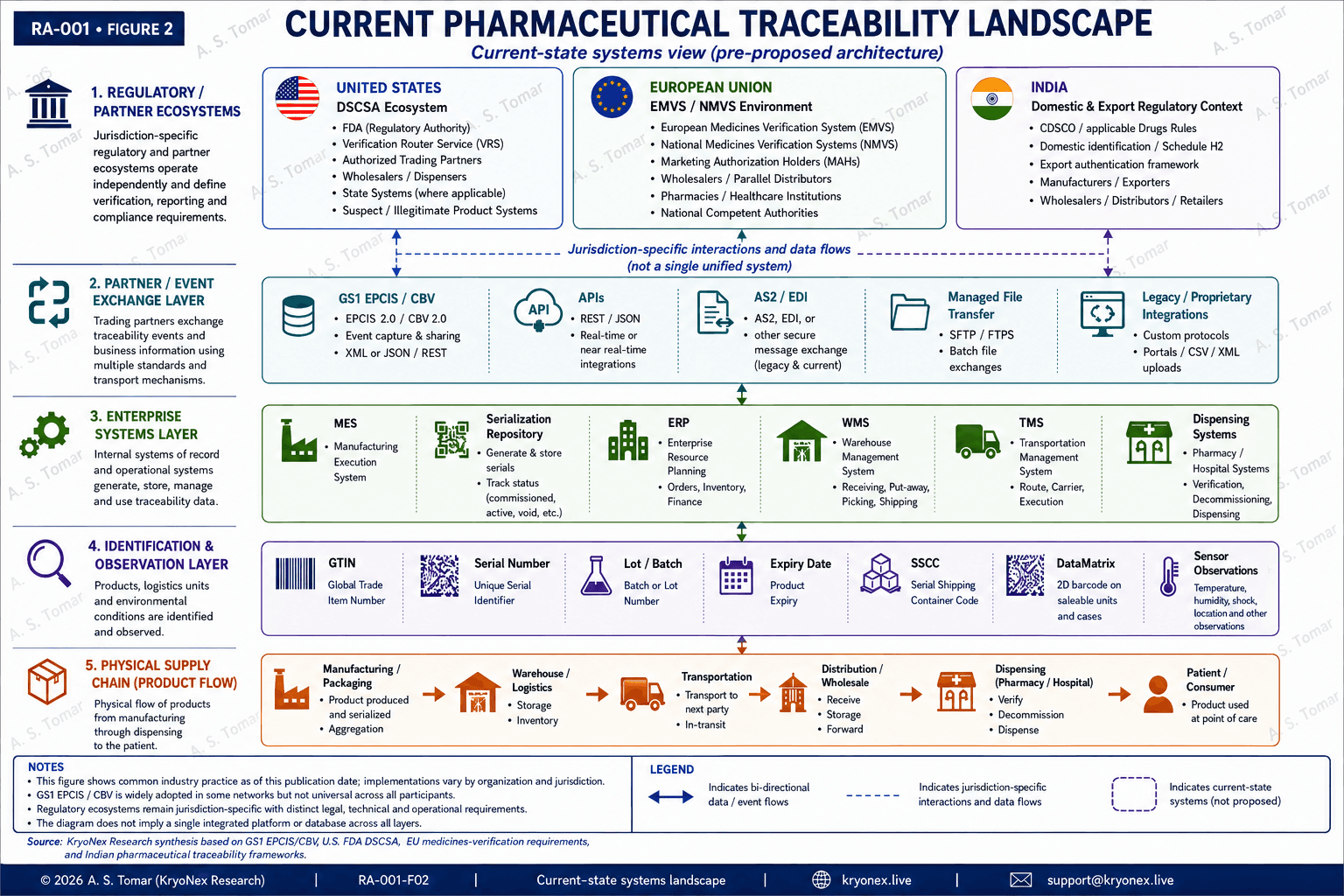
Pharmaceutical traceability is not a single, globally integrated technology stack. Instead, relevant information is created, maintained, exchanged, and verified across multiple independently governed environments (F02). These environments include product and logistics-unit identification; serialization and aggregation systems; MES, ERP, WMS, TMS and serialization repositories; GS1 EPCIS / CBV event exchange; trading-partner interfaces and verification mechanisms; dispensing and endpoint systems; and jurisdiction-specific regulatory or partner ecosystems (such as US DSCSA ATP lookup, EU EMVS spokes, and Indian CDSCO domestic/export portals, including historical DAVA configurations [16] transitioned under the withdrawal of Para 2.76 of the Handbook of Procedures 2023 by DGFT Public Notice No. 44/2024-25-DGFT [6]).
These components can interoperate while retaining separate ownership, governance, authority, and system-of-record responsibilities.
The architectural significance of F02 is therefore not that existing traceability infrastructure is absent. Substantial infrastructure already exists. The relevant question is where assurance must cross organizational, physical, identity, observation, or system boundaries.
4. Trust & Visibility Boundaries
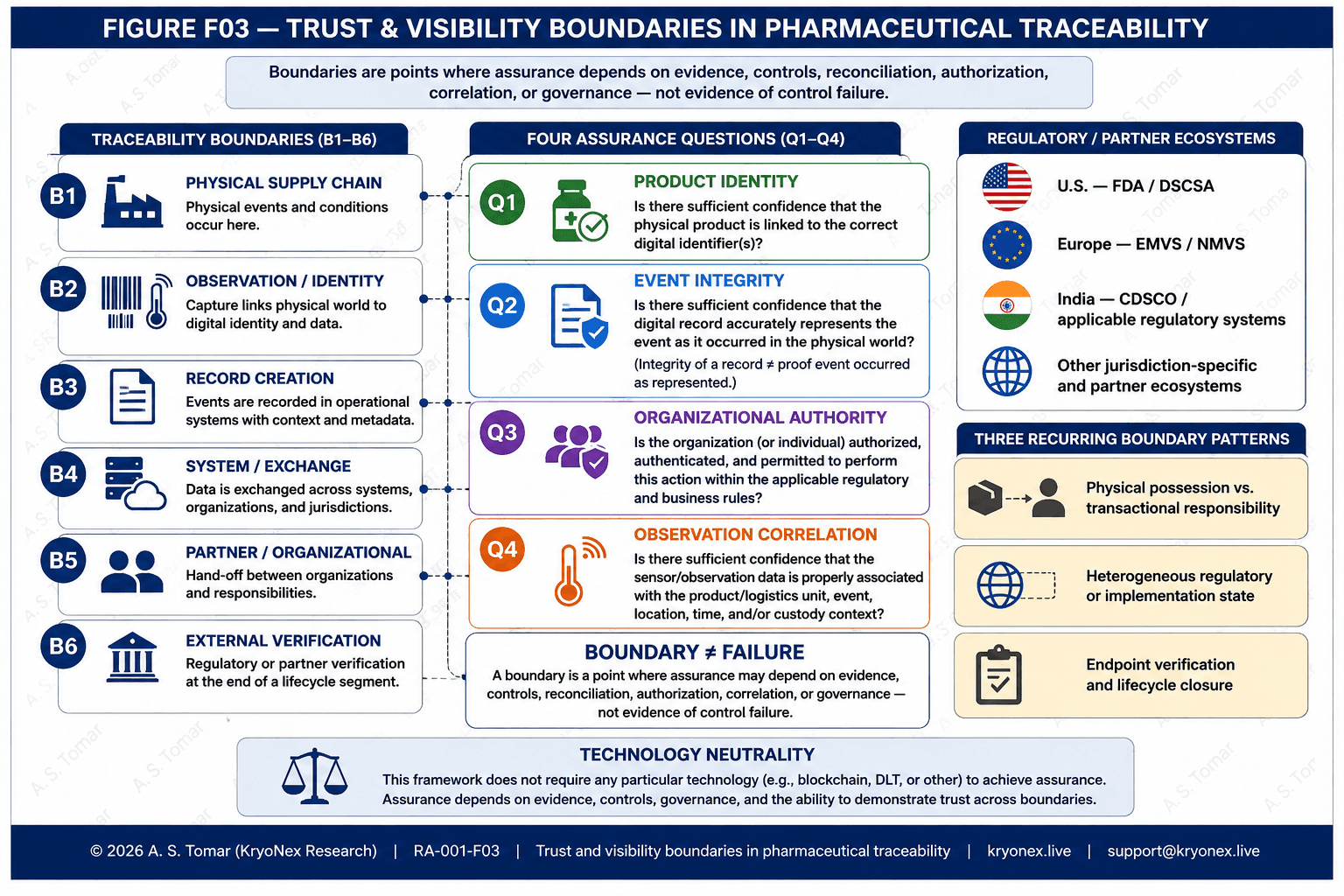
F03 introduces the principle “Boundary ≠ Failure.”
A boundary identifies a transition at which assurance may depend on evidence, controls, reconciliation, authorization, correlation or governance. The existence of a boundary does not itself demonstrate a control failure or traceability weakness.
Preserve these four assurance questions: - Product Identity — Is sufficient confidence established that the physical product corresponds to the digital identifier being used? - Event Integrity — Can the origin, sequence, timing and representation integrity of a digital traceability event be assessed? Digital-record integrity must not automatically be presented as proof that the represented physical event occurred exactly as recorded. - Organizational Authority — Can the participating organization be identified and can its relevant authorization or status be evaluated for the applicable interaction? - Observation Correlation — Can an environmental or logistics observation be associated with the relevant product, logistics unit, event, location, time interval or custody period at the granularity required by the use case?
Preserve these three recurring boundary patterns: physical possession versus legal/transactional responsibility; heterogeneous regulatory/implementation state; endpoint verification and lifecycle closure.
F03 must remain vendor-neutral and non-prescriptive. Do not establish blockchain, DLT, credentials, IoT or another technology as the required solution.
5. Proposed Reference Architecture
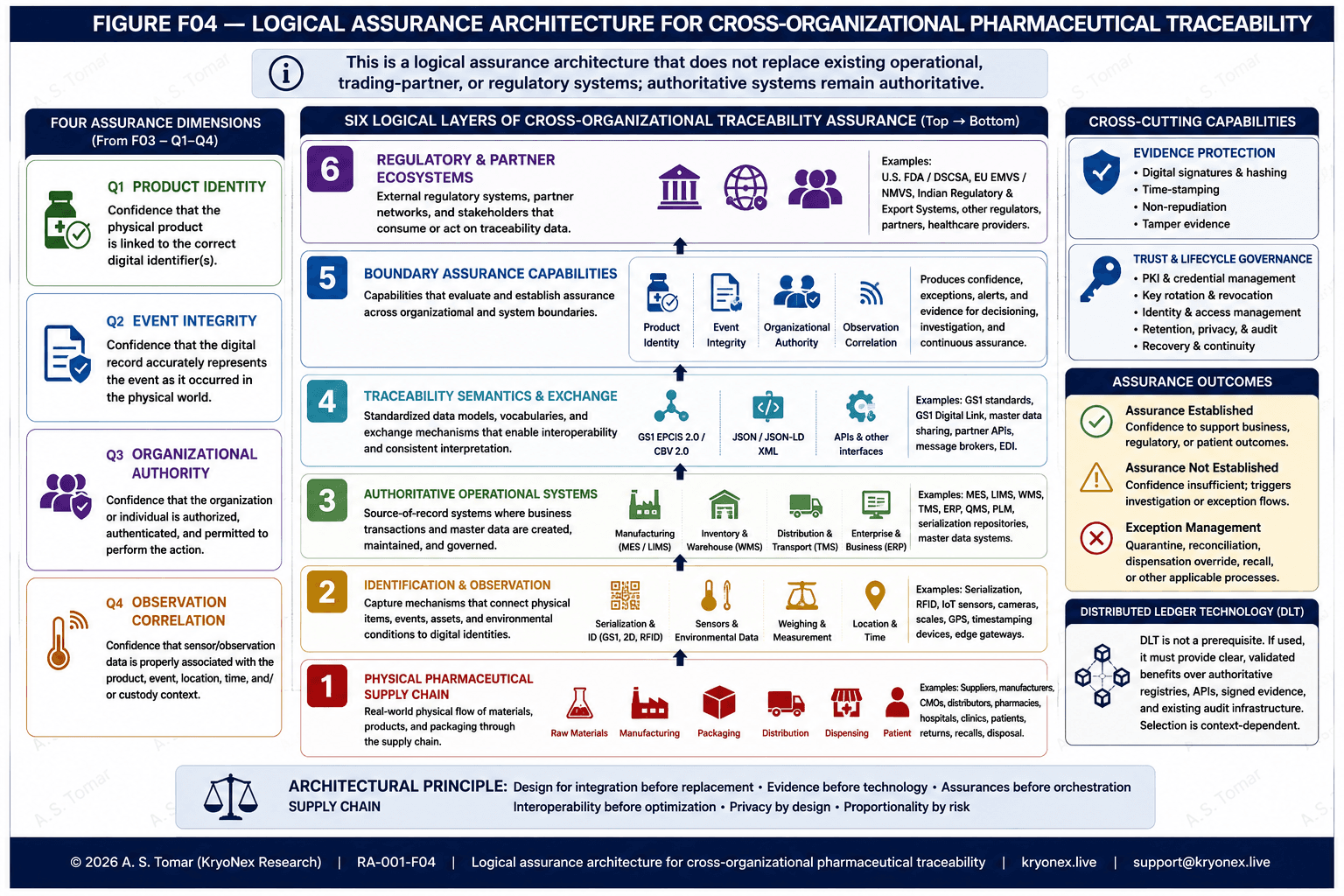
The proposed reference architecture defines a vendor-neutral logical framework where existing operational and regulatory systems remain authoritative, while boundary-assurance capabilities strengthen cross-organizational verification without requiring replacement of those systems (F04).
The logical architecture comprises six distinct layers: 1. Physical Pharmaceutical Supply Chain 2. Identification & Observation 3. Authoritative Operational Systems 4. Traceability Semantics & Exchange 5. Boundary Assurance Capabilities 6. Regulatory & Partner Ecosystems
Boundary Assurance Dimensions Boundary Assurance Capabilities operate as decoupled logical functions addressing four core dimensions: * Product Identity: Verifying that the physical product units and packaging features correspond to the digital identifiers (e.g., serial numbers, GTINs) without requiring a centralized registry. * Event Integrity: Evaluating the origin, timing, and sequence of digital traceability events. (Note: Event integrity does not establish physical truth, meaning digital-record integrity does not automatically prove that the represented physical event occurred exactly as recorded). * Organizational Authority: Evaluating the identity, credential status, and role authorization of the participating partner (Note: Credential verification does not equal transaction authorization). * Observation Correlation: Associating physical environmental telemetry (e.g., temperature logs) with product identifiers, event timestamps, or custody intervals.
Cross-Cutting Controls * Evidence Protection: Ensuring that traceability assertions, signatures, and exchange logs are protected against tampering or retroactive modification. * Trust & Lifecycle Governance: Rules governing key management, identity credential lifecycles, and policy reconciliation across trading networks.
Operational Outcomes The assurance architecture is designed to support normal supply-chain workflows (e.g., receiving, shipping, and dispensing) as well as exception, reconciliation, investigation, or quarantine processes where suspect or damaged product alerts are triggered.
Technology & Shared Ledger Constraints Decentralized ledger technology (DLT) is not a mandatory or default layer of this reference architecture. Shared-ledger mechanisms may only be described as conditional candidates where independently governed shared state is justified after considering governance, privacy, latency, complexity, and operational requirements.
Important Architectural Distinctions To prevent security misinterpretations, the architecture maintains explicit boundaries between physical states and digital assertions: * Event integrity does not establish physical truth: A validated cryptographic event record does not prove the physical container was loaded or handled correctly. * Credential verification does not equal transaction authorization: Confirming that a partner is an Authorized Trading Partner (ATP) does not authorize them to execute specific transactions. * Device identity does not establish calibration: Verifying the cryptographic signature of an IoT temperature sensor does not prove the sensor is calibrated or functioning correctly. * Immutability does not establish correctness: Storing an incorrect or fraudulent serialization record in an immutable log does not make the record correct. * EPCIS provides traceability semantics but does not itself establish trust: While EPCIS provides the semantic structure for event exchange, the trust in every underlying assertion must be verified at the boundary. * Authoritative data ownership remains with the appropriate operational or regulatory system: No global, centralized database holds custody of the end-to-end supply chain data; each entity retains ownership of its system of record.
6. Engineering Considerations
Implementations should define performance requirements according to workload, packaging-line throughput, event volume, verification latency, network conditions, availability targets, and regulatory or operational constraints. Performance requirements should be measured at individual system boundaries rather than assumed uniformly across the architecture. Legacy interoperability: Where organizations continue to operate EPCIS 1.2 or other legacy exchange formats, implementations may require transformation or compatibility services when integrating with EPCIS 2.0 environments.
Architecture Trade-offs
Additional trust mechanisms—including digital signatures, verifiable credentials, shared registries, or distributed ledgers—can improve particular verification properties but also introduce governance, key-management, integration, operational, and latency trade-offs. The appropriate mechanism depends on the trust boundary and use case.
Model Limitations
RA-001 is a logical reference architecture, not a regulatory compliance specification or production implementation design. It does not replace existing regulatory repositories, enterprise systems, serialization platforms, or legally mandated verification processes. Implementation choices will vary according to jurisdiction, organization, product category, risk profile, and existing infrastructure.
References & Data Sources
- U.S. Food and Drug Administration (FDA), *Drug Supply Chain Security Act (DSCSA)* implementation materials, including applicable FDA waivers, exemptions, and stabilization-period guidance.
- GS1, *EPCIS Standard, Release 2.0* and *Core Business Vocabulary (CBV), Release 2.0*.
- European Commission, *Commission Delegated Regulation (EU) 2016/161 of 2 October 2015 supplementing Directive 2001/83/EC by laying down detailed rules for the safety features appearing on the packaging of medicinal products for human use*.
- European Medicines Verification Organisation (EMVO), *The European Medicines Verification System Explained*, EMVO-02343, Version 1.0, 16 June 2023.
- Government of India, Ministry of Health and Family Welfare, *G.S.R. 506(E)*, 22 June 2026, amendment concerning Schedule H2 of the Drugs Rules.
- Government of India, Directorate General of Foreign Trade, *Public Notice No. 44/2024-25*, 31 January 2025, withdrawal of Para 2.76 of the Handbook of Procedures 2023 concerning Track and Trace for exports of drug formulations.
- GS1, *GS1 General Specifications*, including standards for product and logistics-unit identification and the Serial Shipping Container Code (SSCC).
- World Wide Web Consortium (W3C), *Verifiable Credentials Data Model v2.0*, W3C Recommendation, 15 May 2025.
- Open Credentialing Initiative (OCI), *DSCSA Interoperability Profile v3.4.0*, together with applicable credential issuer, wallet, and conformance materials.
- GS1 US, *Verification Router Service and Lightweight Messaging implementation materials for pharmaceutical product-identifier verification workflows*.
- OECD/EUIPO, *Trade in Counterfeit Pharmaceutical Products*, Illicit Trade, OECD Publishing, Paris, 2020.
- Ahmad Musamih, Khaled Salah, et al., “A Blockchain-Based Approach for Drug Traceability in Healthcare Supply Chain,” *IEEE Access*, Vol. 9, pp. 9728–9743, 2021. DOI: 10.1109/ACCESS.2021.3049920.
- World Wide Web Consortium (W3C), *Decentralized Identifiers (DIDs) v1.0*, W3C Recommendation, 19 July 2022.
- International Society for Pharmaceutical Engineering (ISPE), *GAMP 5: A Risk-Based Approach to Compliant GxP Computerized Systems*, Second Edition, 2022.
- Directive 2011/62/EU of the European Parliament and of the Council of 8 June 2011 amending Directive 2001/83/EC as regards the prevention of the entry into the legal supply chain of falsified medicinal products.
- Pharmaceuticals Export Promotion Council of India (Pharmexcil), *iVEDA Web Portal — Beta Version launched and LIVE NOW FOR COMPANY REGISTRATION & DATA UPLOAD*, Circular PXL/HO/Cir-039/2020-21, 25 June 2020.
Revision History
| Version | Date | Changes |
|---|---|---|
| Pre-RA-001 | Nov 2024 | Engineering and implementation work on pharmaceutical supply-chain traceability concepts that later informed RA-001 began in November 2024. This work was undertaken as implementation and engineering activity, not as a formally versioned KryoNex Research publication. |
| 0.3 | 2026-07-24 | Initial RA-001 working draft established for formal technical review. |
| 0.4 | 2026-07-27 | Evidence, regulatory state, standards terminology, claim-to-evidence mappings, F01-F04 architecture, citations, public-disclosure boundaries, editorial state, and publication assets reconciled through final v0.4 technical review. |
| 1.0 | 2026-07-27 | First public release of RA-001 following completion of technical review, evidence reconciliation, regulatory and standards review, architecture consistency review, public-disclosure review, editorial review, and final cross-artifact release verification. |
Research Provenance
RA-001 is maintained as part of the KryoNex Research publication series. Public research artifacts, version history, and supporting technical materials are available through the KryoNex Research repository.Archive DOI: https://doi.org/10.5281/zenodo.21630864
© 2026 A. S. Tomar. Published by KryoNex Research.
Licensed under the Creative Commons Attribution-NonCommercial-NoDerivatives 4.0 International License (CC BY-NC-ND 4.0).
RA-001 is a vendor-neutral logical reference architecture published for technical and conceptual review. It does not represent regulatory approval, validated production architecture, legal advice, compliance certification, or endorsement by the FDA, EU, CDSCO, GS1, W3C, or any other authority.